
Insider Trading Q3 2026: $21 Billion Sold, and Two CEOs Who Sold Near the Top Are Buying

By Chad Hartman
Published · Last updated
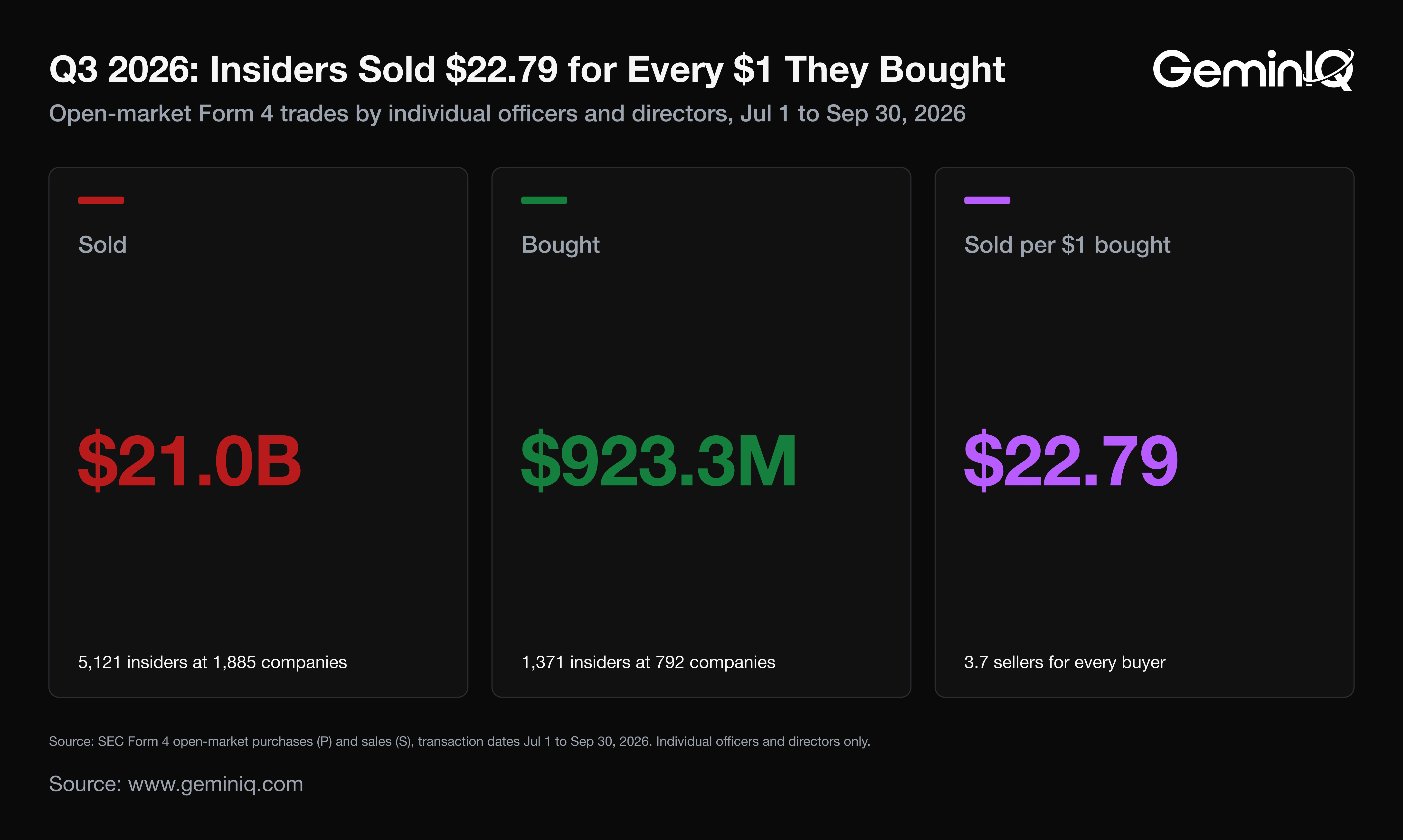
Corporate insiders sold $21.0 billion of their own stock in the third quarter of 2026 and bought $923 million. That is $22.79 sold for every dollar bought, by 5,121 sellers against 1,371 buyers. Read as one number, it says the people with the best view of American companies spent the summer heading for the exits.
The number does not survive a closer look at who is inside it. Fifty-one people account for nearly half of the selling. Hundreds more sold on a calendar. And a handful of the buyers did something the Form 4 record shows they had not done in years: they reversed course on their own stock, at prices far below where they had sold it.
This study reads every open-market Form 4 purchase (transaction code P) and sale (code S) with a transaction date between July 1 and September 30, 2026, as filed with the SEC and loaded into GeminIQ's raw Form 4 feed. It counts individual officers and directors only, which excludes 10% holders filing as funds, closed-end and interval funds, and SPAC sponsor purchases. Before counting, we removed rows with impossible prices (one filing implied a share price of $180,000 for a coffee chain, another $748,119 for a shipping partnership), dropped one issuer whose prices were reported in Taiwan dollars, and merged 341 duplicate rows created by joint filers and Form 4/A amendments. For eight companies, the quarter's trades are then set against each insider's full Form 4 history back to 2008 and the company's own 10-K and 10-Q filings.
Fifty-One Sellers, Half the Money
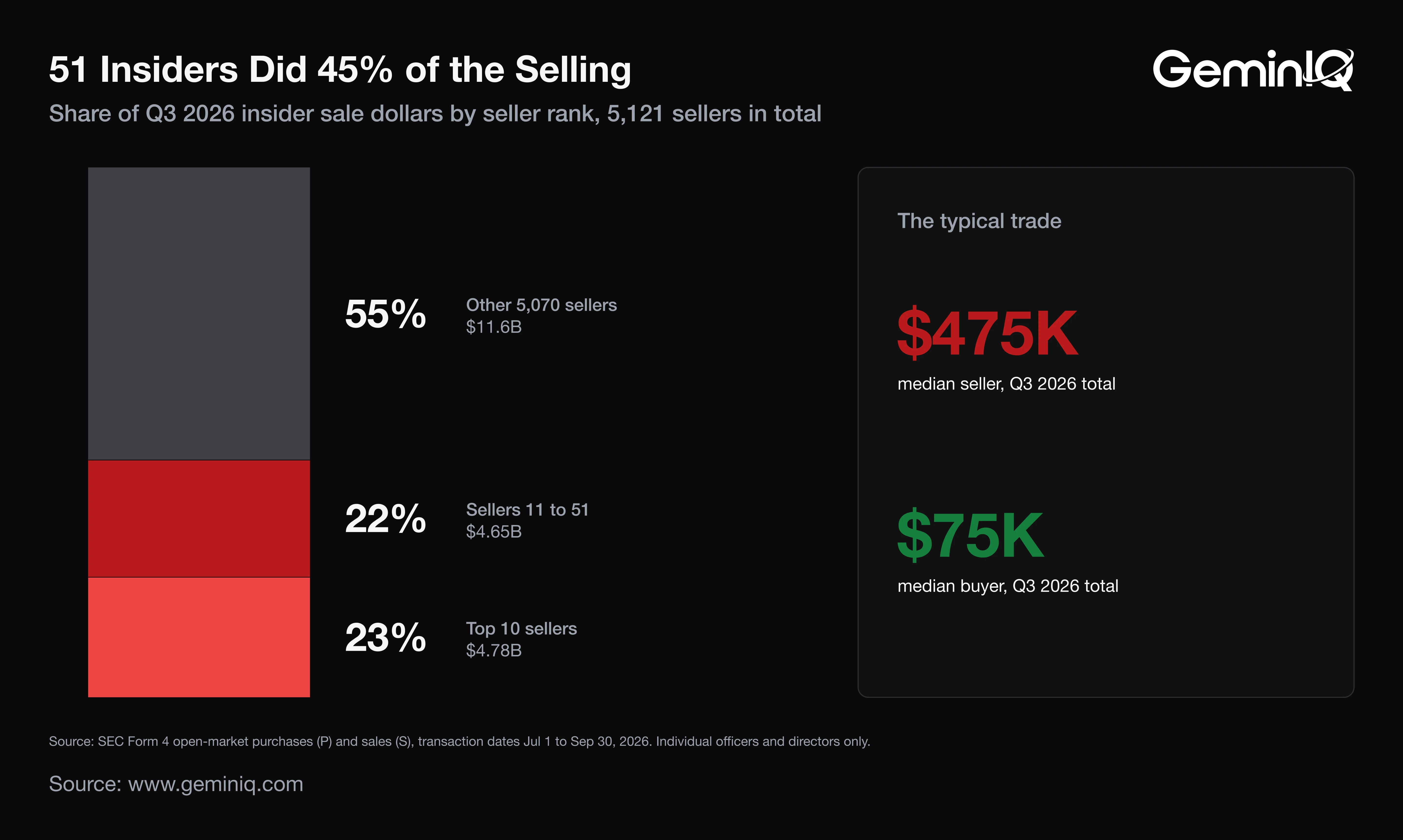
The top ten sellers alone moved $4.78 billion, about 23% of all insider sales. The top 51, one percent of the seller count, moved $9.43 billion, or 45%. The median seller sold $475,000 over the whole quarter. A $21 billion headline built on that distribution describes a few dozen very large holders far more than it describes the typical executive.
The calendar explains another slice. 413 insiders sold in July, August and September, every month of the quarter, and those regular sellers account for 21% of sale dollars. Regularity matters because of what the academic record says about it. Cohen, Malloy and Pomorski (Journal of Finance, 2012) split insiders into "routine" traders, who trade in the same month year after year, and "opportunistic" traders, who do not. Routine trades carried essentially no predictive value; opportunistic trades earned value-weighted abnormal returns of about 82 basis points per month. Lakonishok and Lee (2001) and Jeng, Metrick and Zeckhauser (2003) reached a related conclusion two decades earlier: insider purchases carry information, insider sales mostly do not.
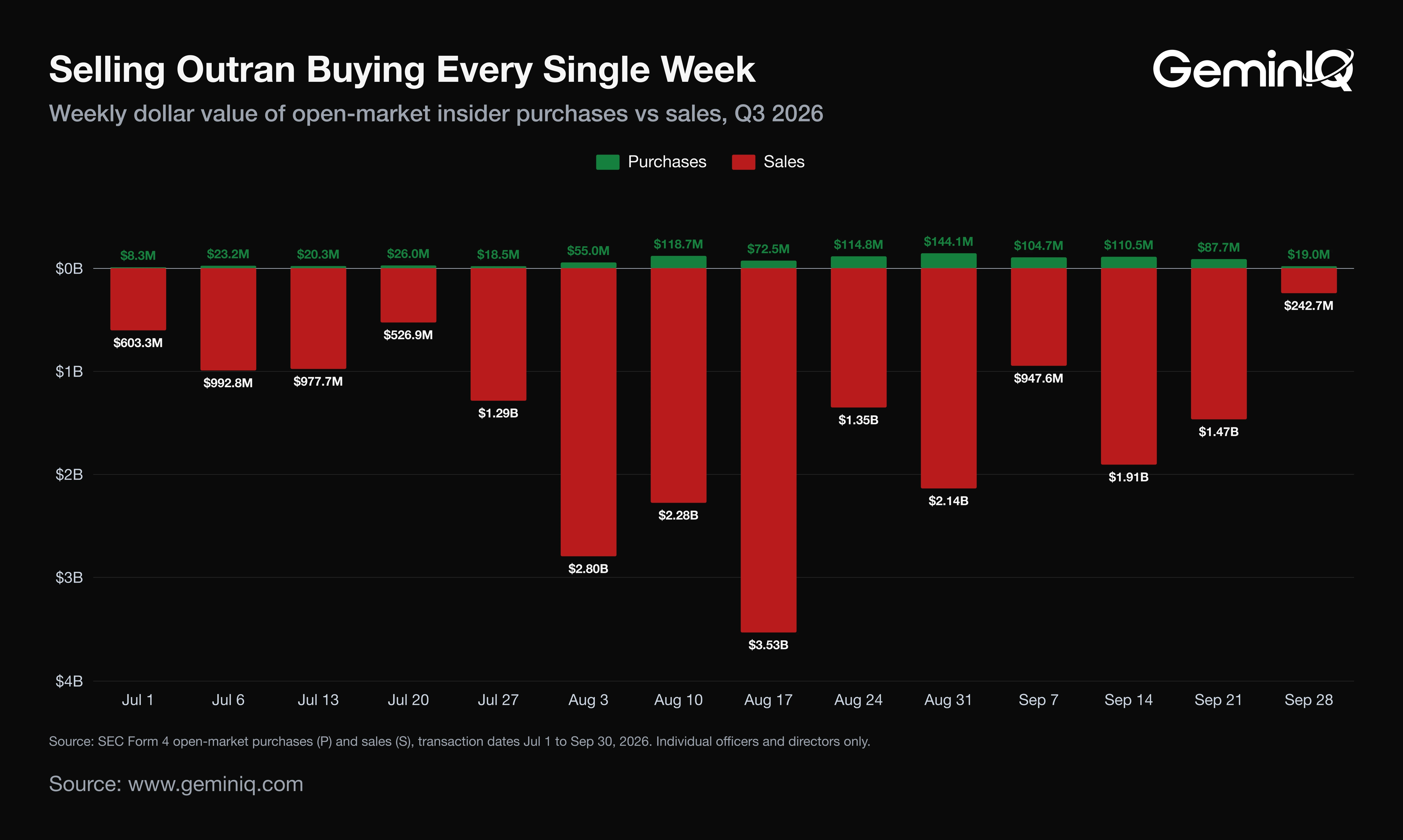
Selling outran buying in every week of the quarter and peaked at $3.53 billion in the week of August 17, as post-earnings trading windows opened. Chief executives were no exception: 680 CEOs sold $6.99 billion, while 289 CEOs bought $270 million. Fortune, citing VerityData, reported that the count of unique insider buyers across U.S. companies fell 18% from the second quarter to the third, with financial-sector buyers at their lowest since that dataset began in 2004.
So the useful question is narrower than "are insiders bearish." It is which individual trades broke a pattern, and whether the company's filings support the trade.
The Sellers: NVIDIA and Amazon
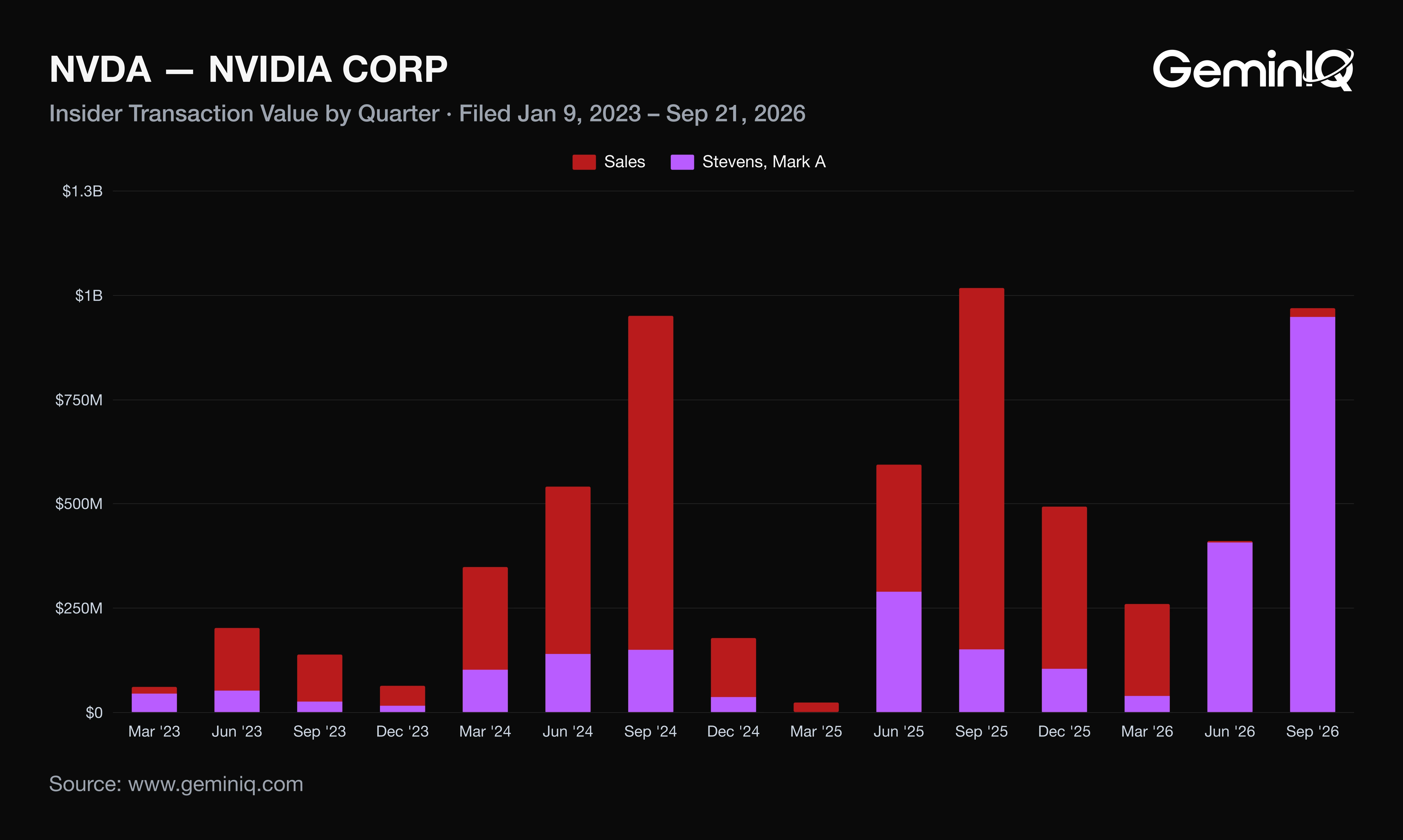
NVIDIA director Mark Stevens was the quarter's largest individual seller, a ranking Bloomberg also reported from Washington Service data. GeminIQ's Form 4 feed shows six sales between August 31 and September 18 totaling $947.6 million at an average of $223.65 a share. His selling has escalated each year: $425.7 million in 2024, $542.5 million in 2025, and $1.39 billion in 2026 through September. NVIDIA insiders as a group have sold $5.78 billion since January 2024, and the last open-market purchase by any NVIDIA insider in the feed was in December 2020.
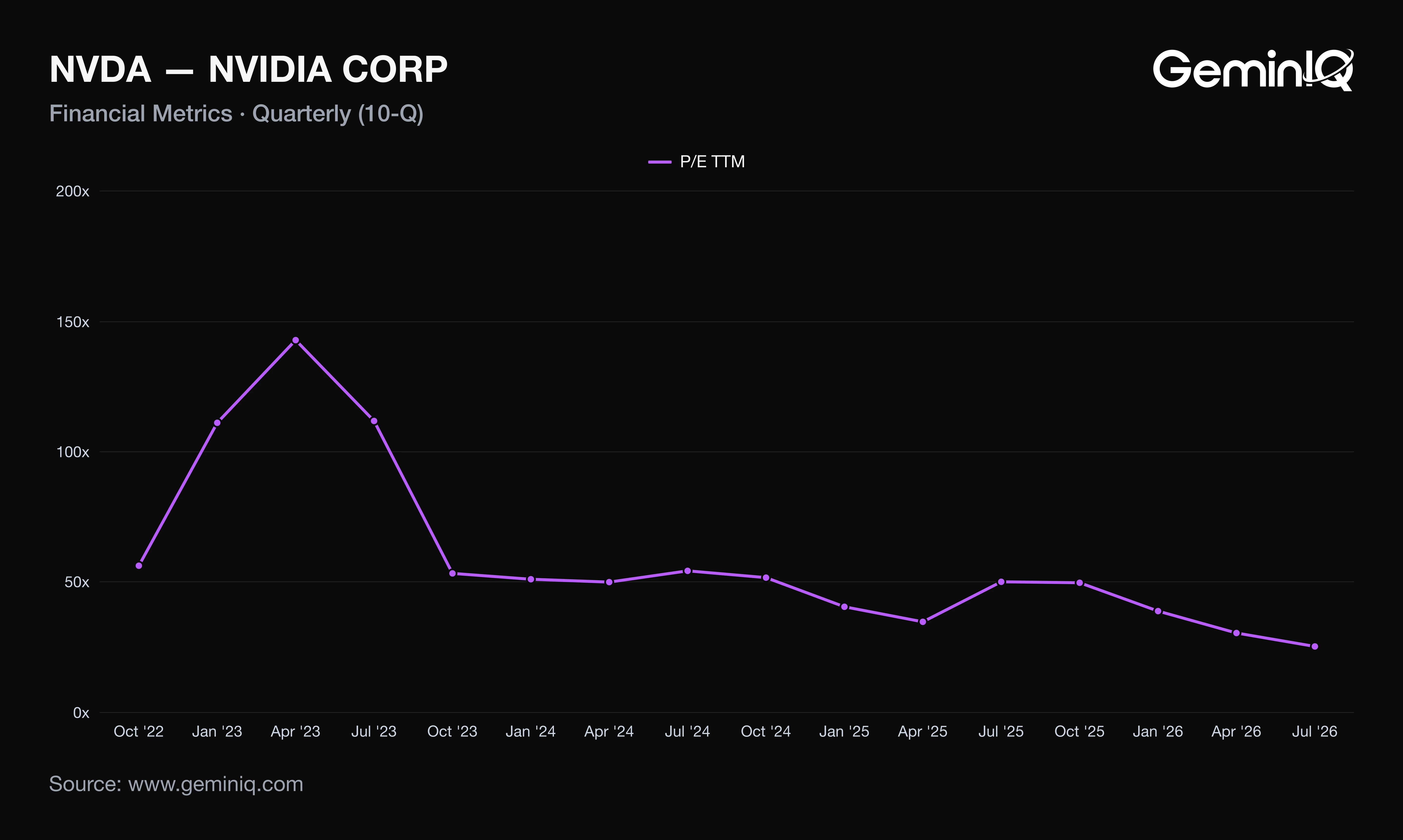
The selling is happening into a stock that is cheaper on its own earnings than at any point since early 2019. NVIDIA's trailing P/E was 25.2 at the July 31, 2026 quarter end, down from 54.2 two years earlier, on trailing revenue of $303.0 billion (up 83% year over year) and a trailing operating margin of 65.2%, the highest in the 69 quarters of filings GeminIQ holds. A director selling a near-billion dollars into compressing multiples and record margins reads as diversification of a very concentrated position, not as a call on the business. One filing detail cuts against the most common defense: the Rule 10b5-1 box on his September 18 Form 4 is not checked, so that sale was not disclosed as part of a pre-arranged plan. NVIDIA closed at $229.28 on October 9, 2.5% above his average Q3 sale price.
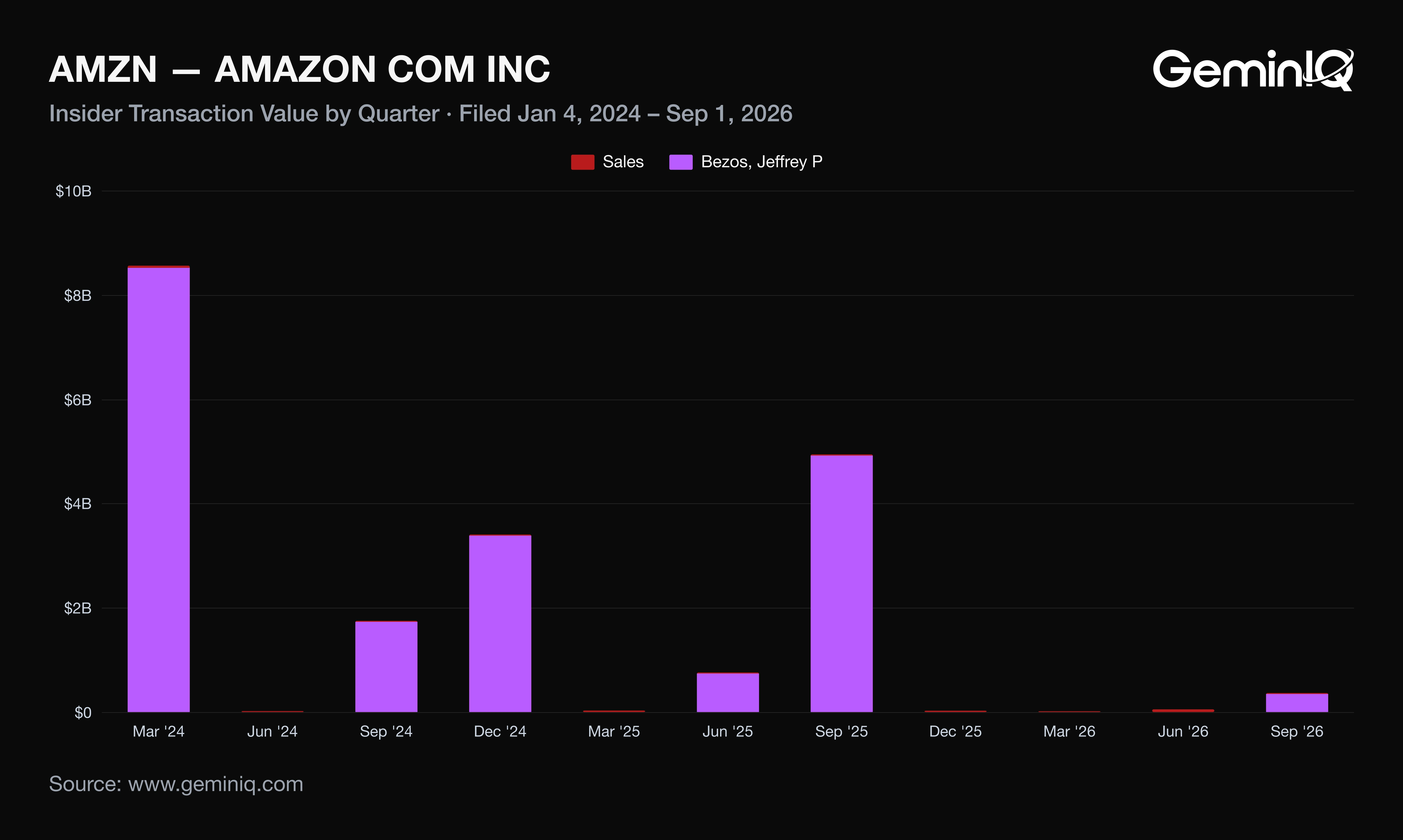
Jeff Bezos sold 1,209,649 shares of Amazon at $286.41 on August 3, about $346.5 million, under a 10b5-1 plan adopted in November 2025. In context, that is a small year for him. Bezos sold $13.64 billion of Amazon in 2024 and $5.66 billion in 2025, so his 2026 selling to date is about 6% of last year's.
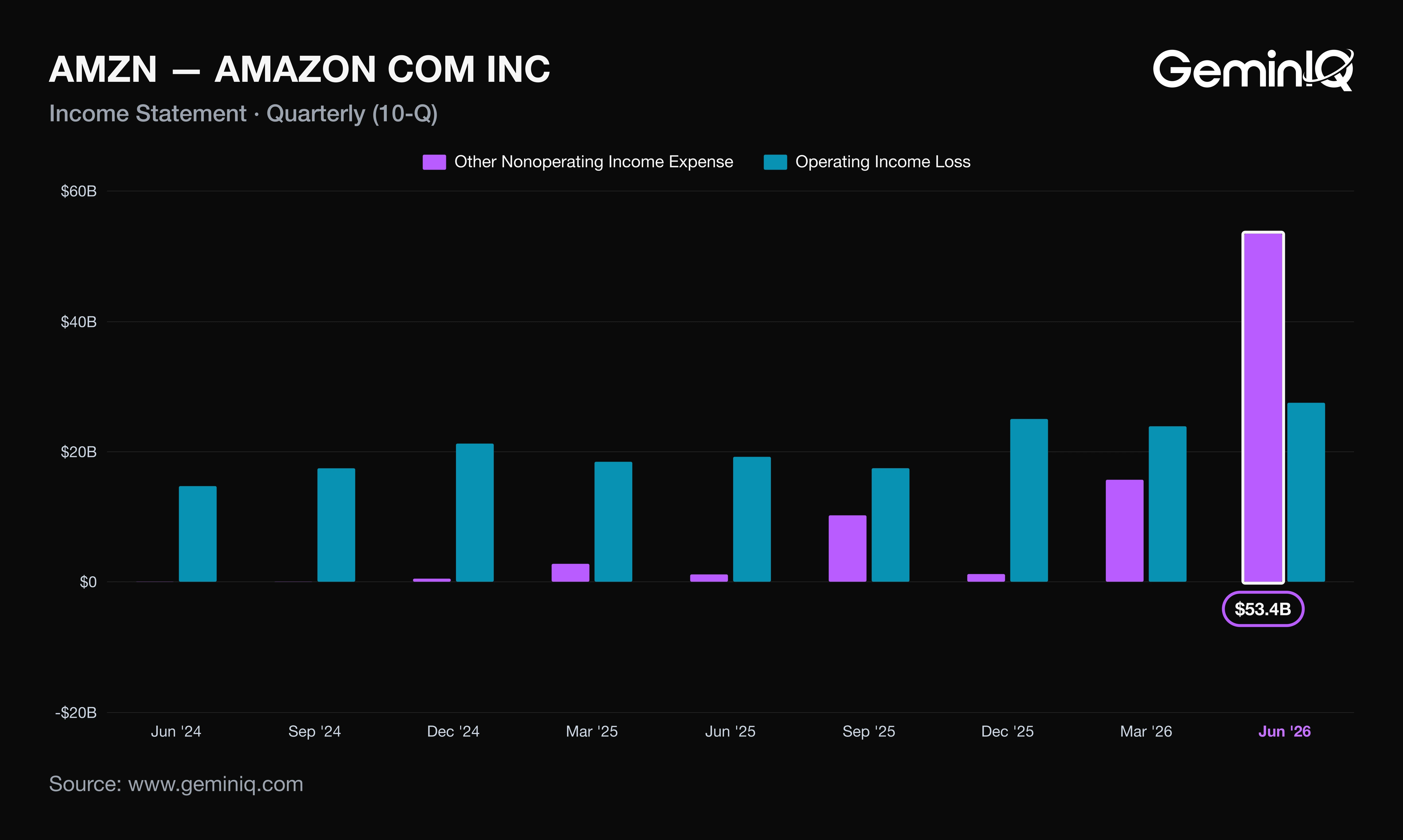
Amazon's earnings deserve the scrutiny his sale does not. The company's trailing P/E of 19.0 at June 30, 2026 is the lowest in GeminIQ's records going back to 2009, which looks like a bargain until the 10-Q is opened. In the June quarter, Other Nonoperating Income Expense was $53.4 billion against Operating Income Loss of $27.5 billion. On a trailing basis, pretax income of $175.5 billion sits on top of operating income of $93.7 billion, so close to half of pretax earnings came from below the operating line.
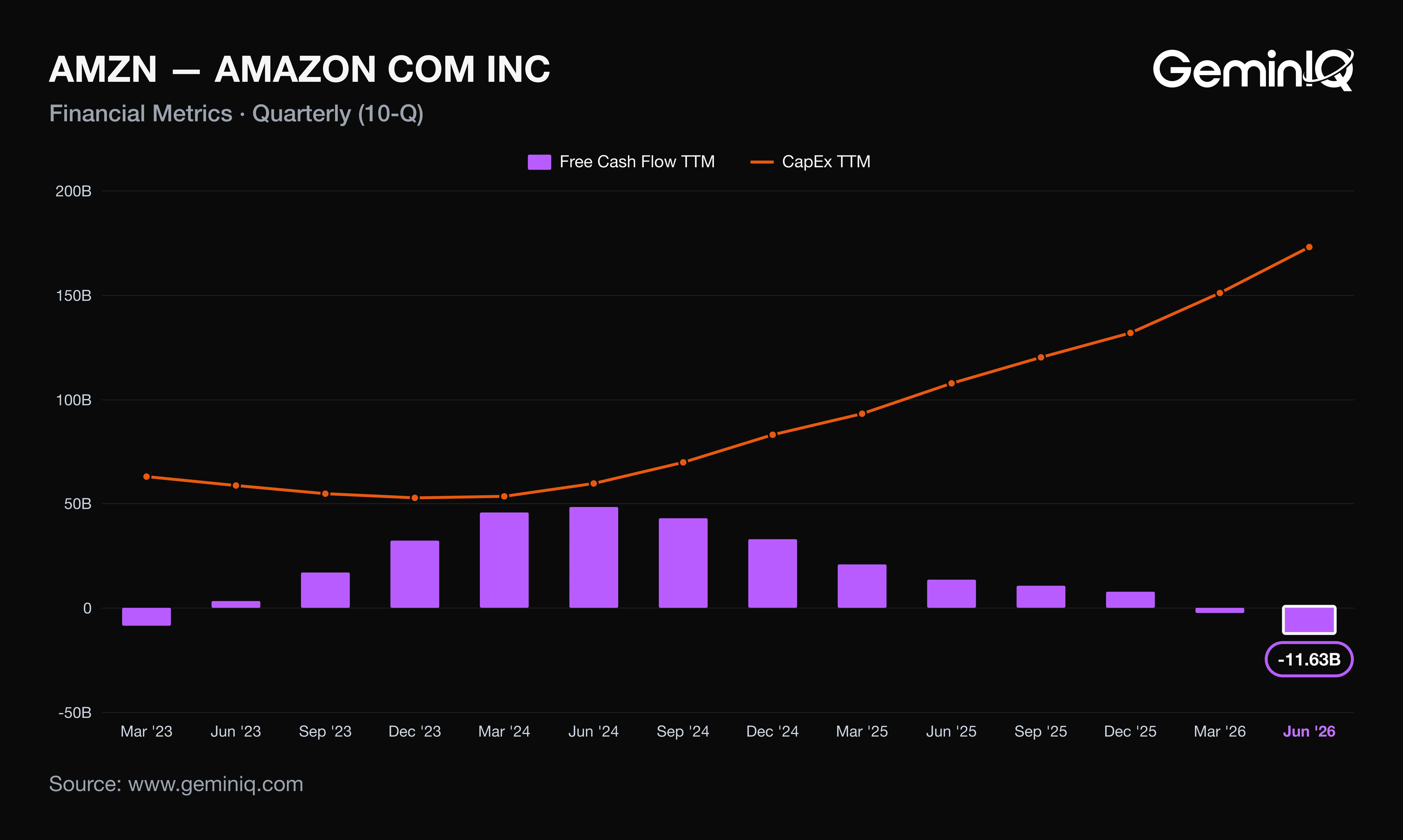
Cash tells the same story from the other side. Trailing capital expenditures reached $173.0 billion, more than triple the $53.5 billion of the twelve months to March 2024, and trailing free cash flow turned negative at -$11.6 billion, the first negative reading since early 2023. Amazon closed at $262.43 on October 9, 8.4% below Bezos' sale price.
Sold Near the Top, Bought the Drop: Boston Scientific and Uber
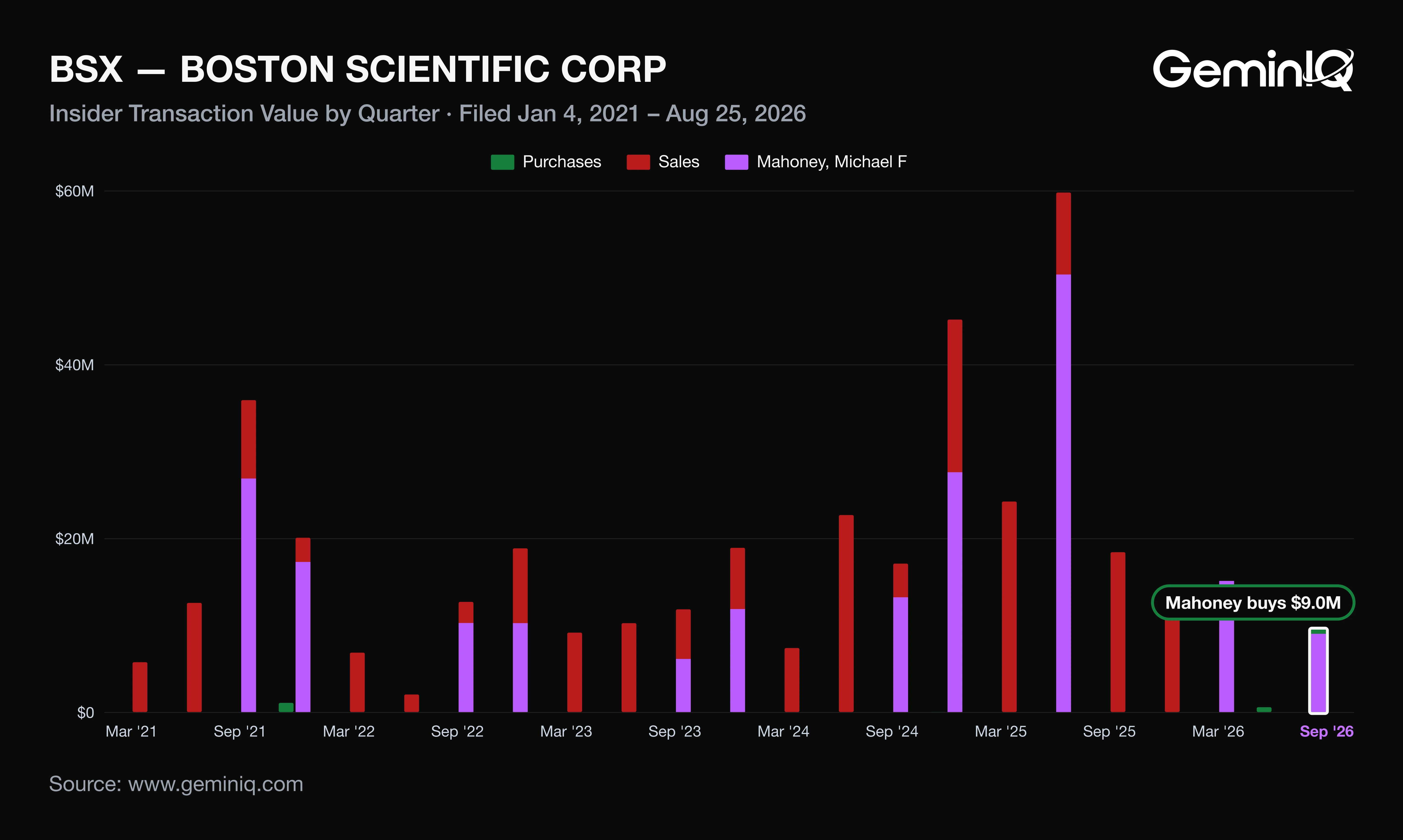
Michael Mahoney, chairman and CEO of Boston Scientific, had not bought a share of his company's stock in the open market since 2014, when he paid $12.89. From 2016 through February 2026 he sold $222.4 million of it. His 2025 sales came at $100.01 to $103.72, close to the stock's high, and his last sale, on February 2, 2026, was 160,901 shares at $93.78. On August 3, 2026, the same day Boston Scientific filed its second-quarter 10-Q, he bought 186,240 shares at $48.33, about $9.0 million, roughly half the price of his last sale.
He was not alone. Four directors, David Habiger, Edward Ludwig, Cheryl Pegus and Susan Morano, bought between May and August at $45.48 to $56.95. That makes five insider buyers in 2026, and Mahoney's February sale is the only insider sale of the year. Every year from 2013 through 2025 had between nine and sixteen insider sellers. The $10.0 million of 2026 insider purchases is the largest annual total in GeminIQ's Boston Scientific record, which runs back to 2008.
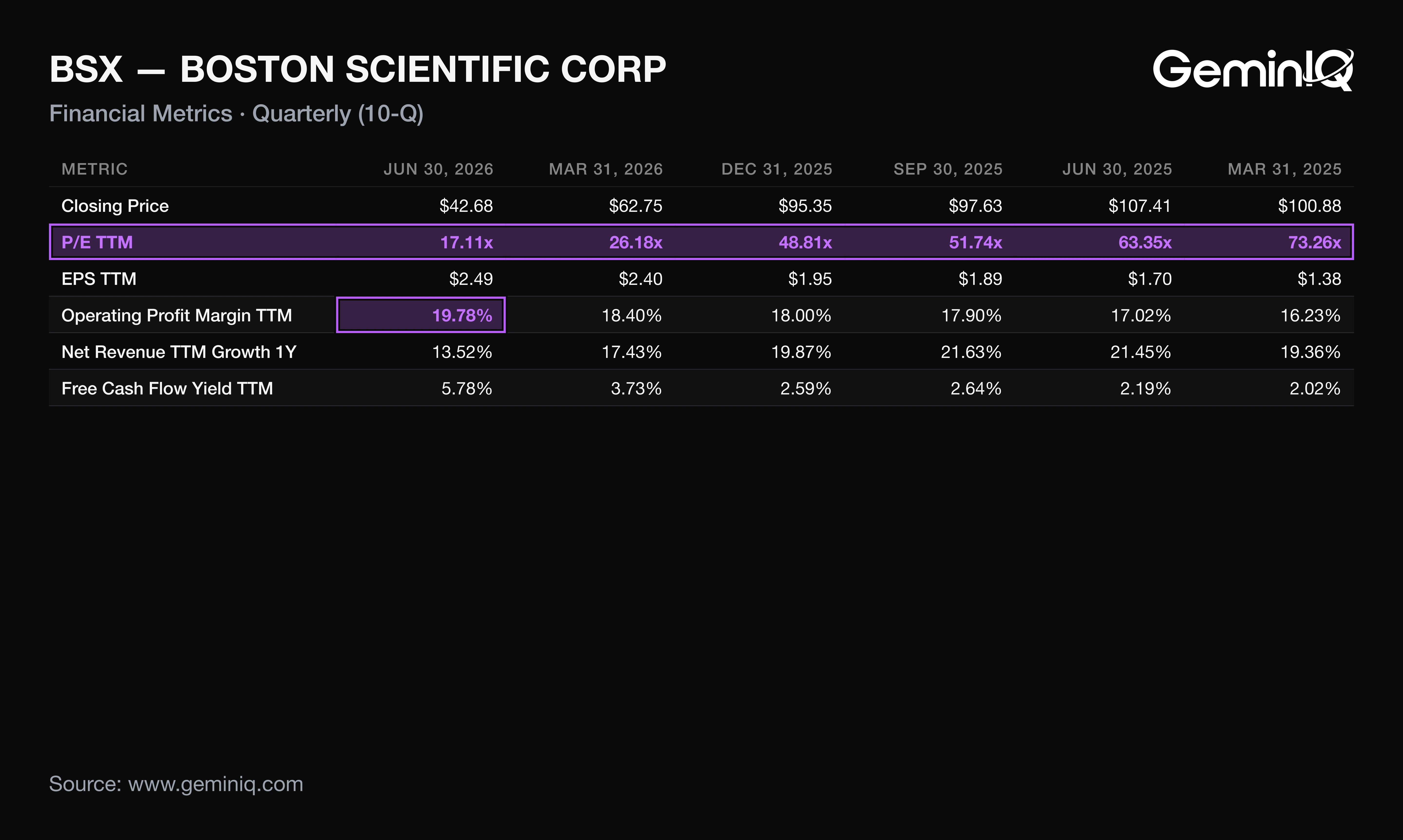
The filings show a business that kept improving while the stock was cut by more than half. Trailing revenue reached $21.0 billion at June 30, 2026, up 13.5% year over year. Trailing operating income rose to $4.15 billion from $3.15 billion a year earlier, and the trailing operating margin of 19.8% is the highest in 69 quarters of Boston Scientific filings. Trailing EPS climbed to $2.49 from $1.70. Over the same stretch, the trailing P/E fell from 73.3 in March 2025 to 17.1, its lowest since 2020, and EV/EBITDA fell to 13.4, its lowest since 2016.
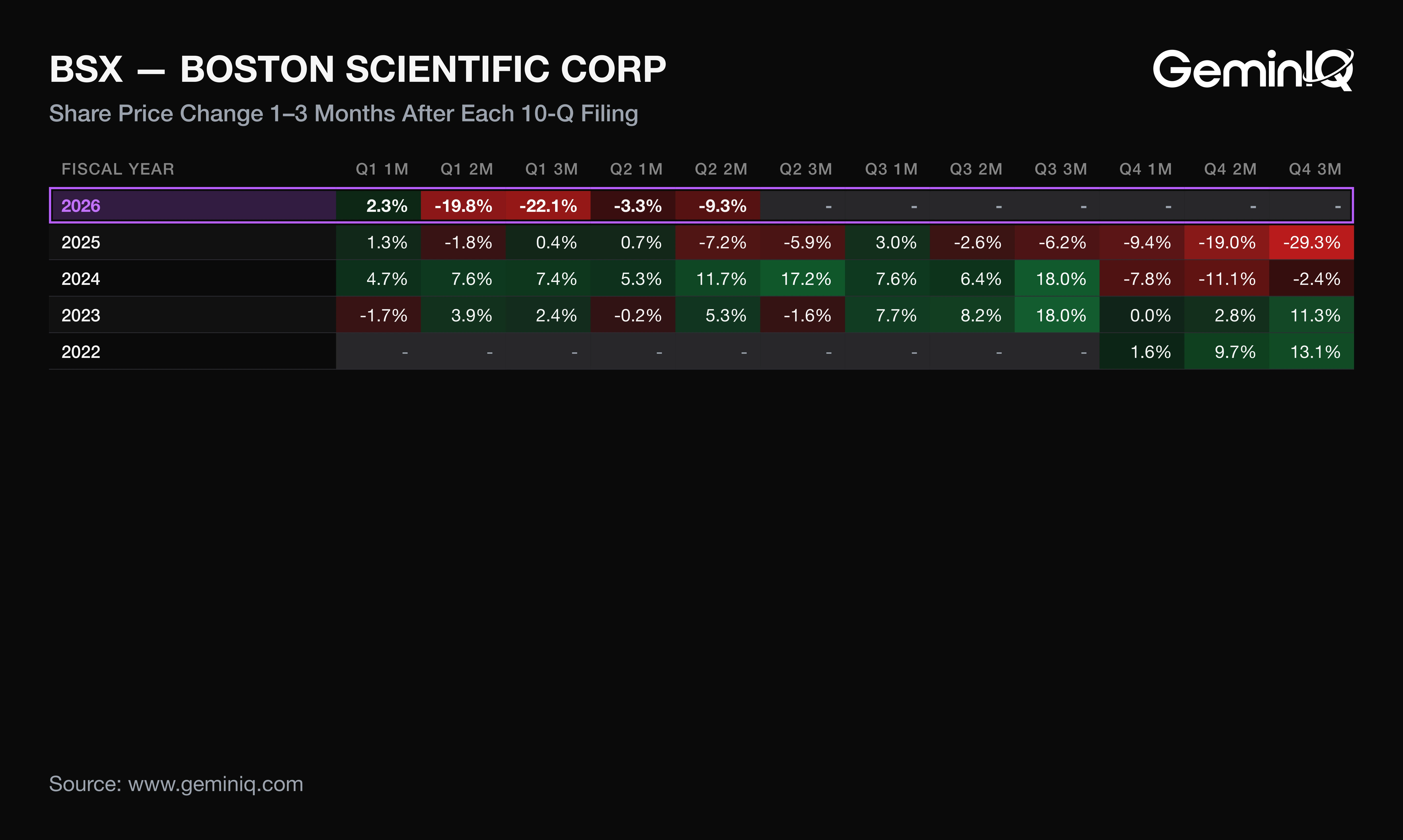
The market's objection is to growth, not to the margin. Boston Scientific cut its 2026 organic growth outlook twice, from 10% to 11% in February down to 5% to 6% in July, and in September disclosed that a cyberattack made even that range unlikely. The heat map records the result: a 29.3% decline in the three months after the 10-K and 22.1% after the first-quarter 10-Q. Mahoney's purchase is a bet that a 17-times multiple already prices the slowdown. As of October 9 it is losing: the stock closed at $42.73, 11.6% below his price, and the third-quarter report is due October 28.
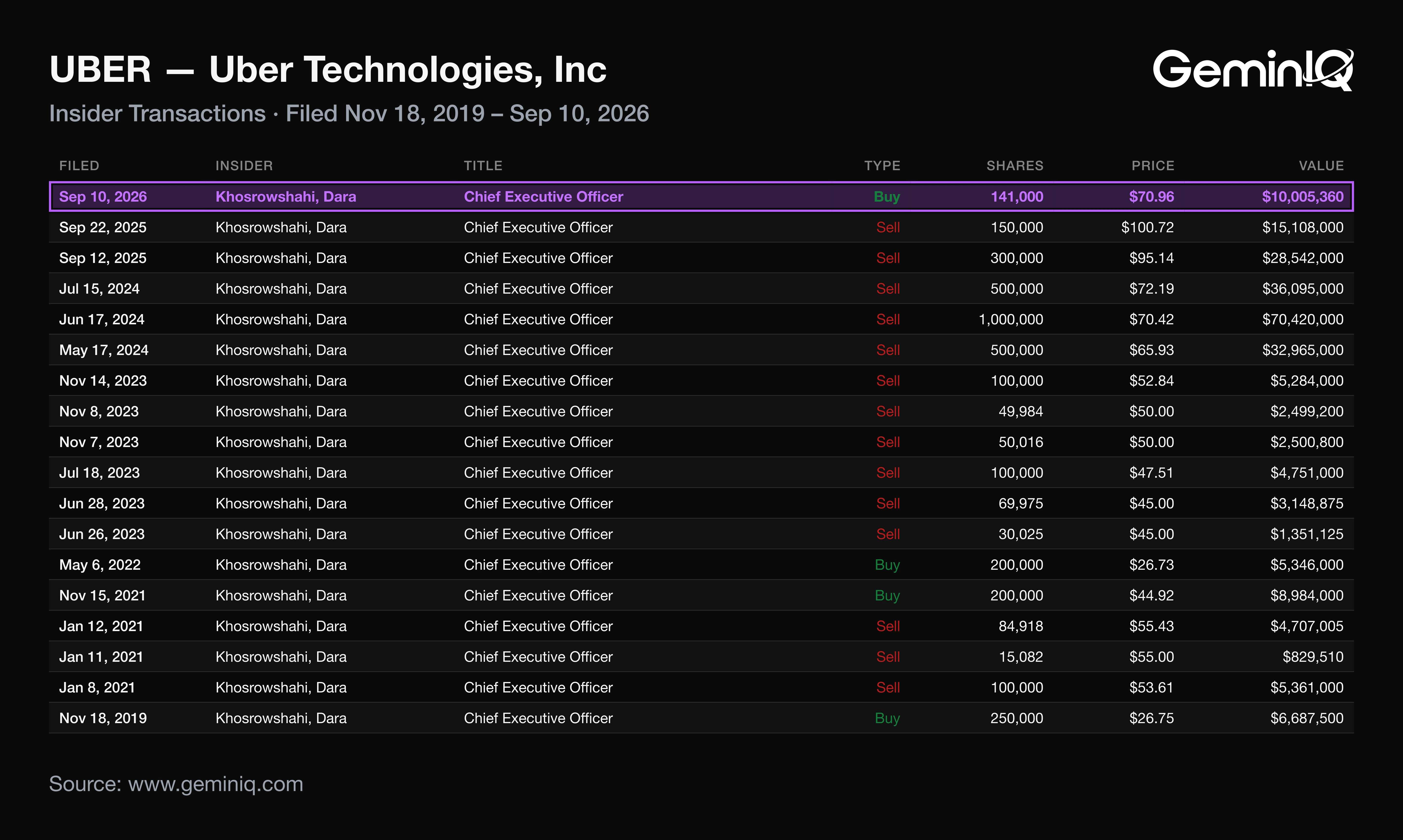
Uber CEO Dara Khosrowshahi has the most complete buy-and-sell record of any CEO in this group. He bought 250,000 shares at $26.75 in November 2019, 200,000 at $44.92 in November 2021 and 200,000 at $26.73 in May 2022. He then sold at $45.00 to $52.84 in 2023, $65.93 to $72.19 in 2024 ($139.5 million), and $95.14 and $100.72 in September 2025, within a few dollars of the stock's 52-week high. Lifetime, he has sold $213.6 million and bought $31.0 million. On September 10, 2026, he bought 141,000 shares at $70.96, about $10.0 million, his first purchase since 2022.
Two other senior executives bought in 2026: CFO Balaji Krishnamurthy ($1.6 million at $71.28 in February) and COO Andrew Macdonald ($5.3 million at $76.04 on September 4). The $16.9 million of 2026 insider buying is the most in any year since Uber's 2019 IPO. Not every insider joined: Jill Hazelbaker sold $2.0 million at $71.31 the day after the CEO bought.
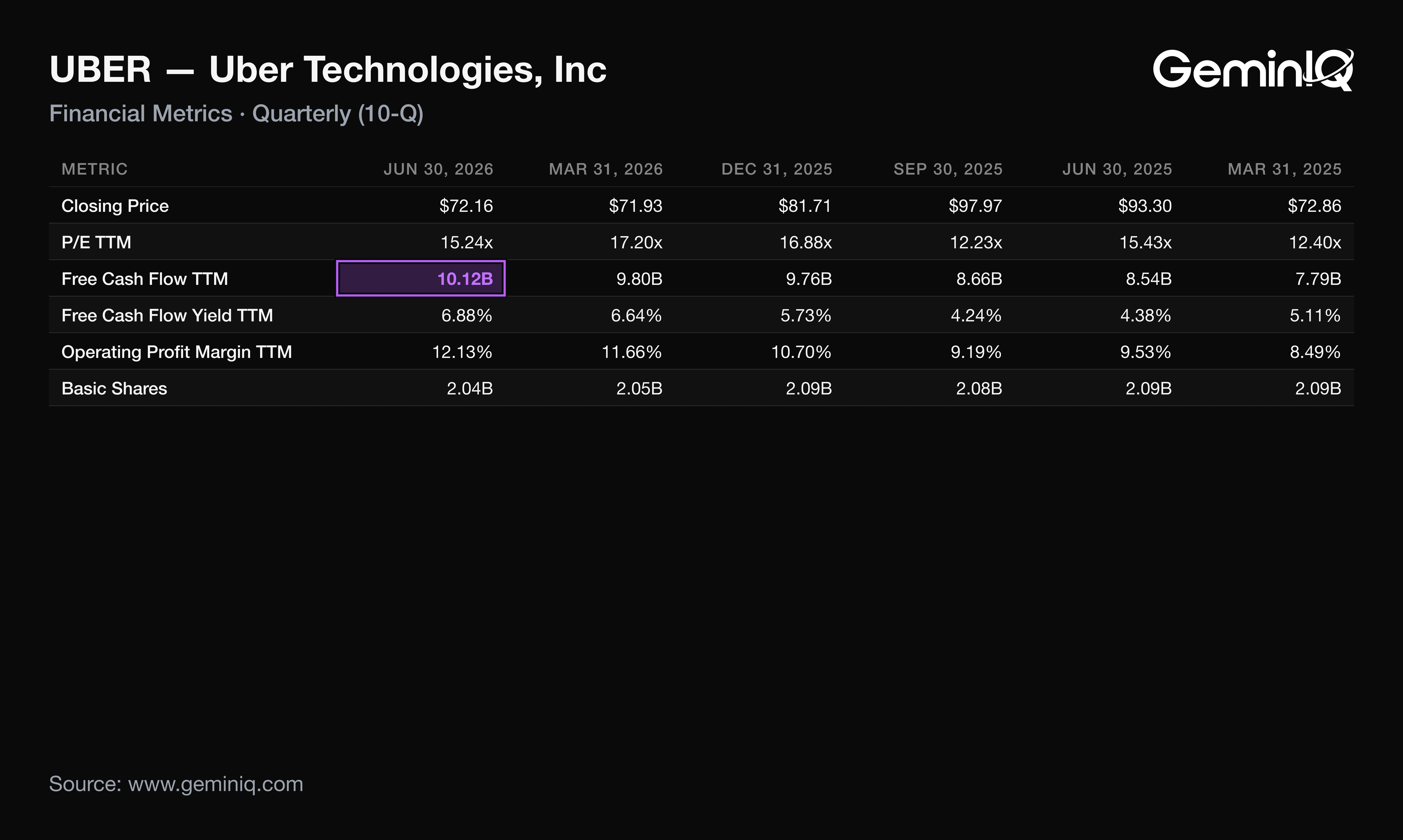
Uber's filings support the buy on the numbers that matter most to an owner. Trailing free cash flow reached a record $10.1 billion, a 6.9% yield on the June 30 market value. The trailing operating margin of 12.1% is the highest in Uber's filing history, and basic shares outstanding fell to 2.036 billion from 2.091 billion a year earlier as buybacks shrank the count by 2.6%. The bear case lives outside the income statement: Uber cut about 3,300 jobs on September 2, and the robotaxi question hangs over a driver network that produces all of that cash. Uber closed at $71.51 on October 9, 0.8% above Khosrowshahi's price.
The Clusters: Dick's and GameStop
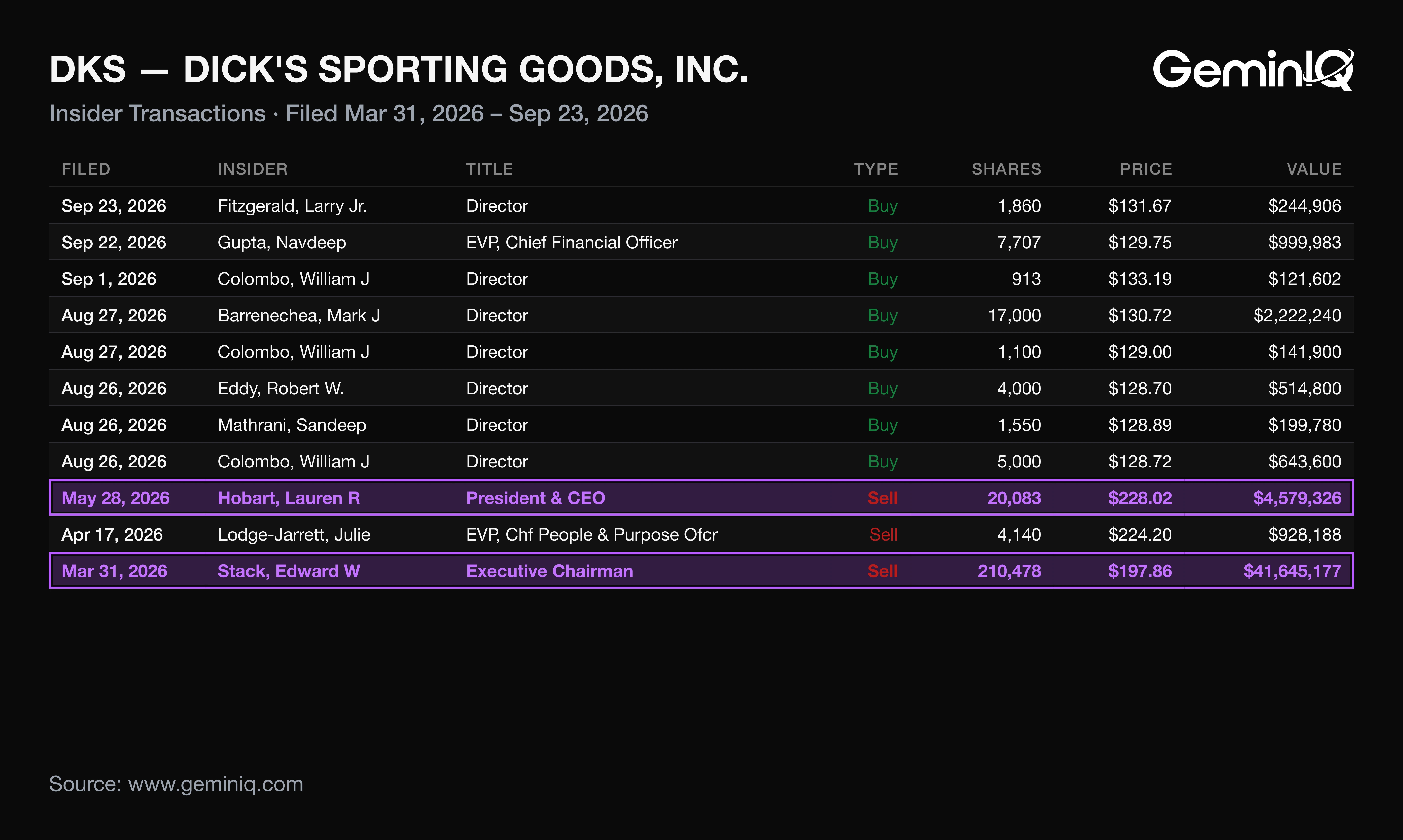
Dick's Sporting Goods produced the quarter's most debatable cluster. Six insiders, five directors and CFO Navdeep Gupta, bought $5.09 million of stock between August 26 and September 23 at $128.70 to $133.19, after the second-quarter miss and guidance cut sent shares down about 30%. Director Mark Barrenechea's $2.22 million was the largest purchase, and Gupta's $1.0 million is a CFO buy, the category Wang, Shin and Francis (2012) found more informative than CEO trades. Six buyers in one year is the most in GeminIQ's Dick's record since 2008; the previous high was four, in 2014.
The two insiders who know the business longest sold instead. Executive Chairman Edward Stack sold $41.6 million at $197.86 on March 31, and CEO Lauren Hobart sold $4.6 million at $228.02 on May 28. Neither appears among the buyers at prices 33% to 44% lower.
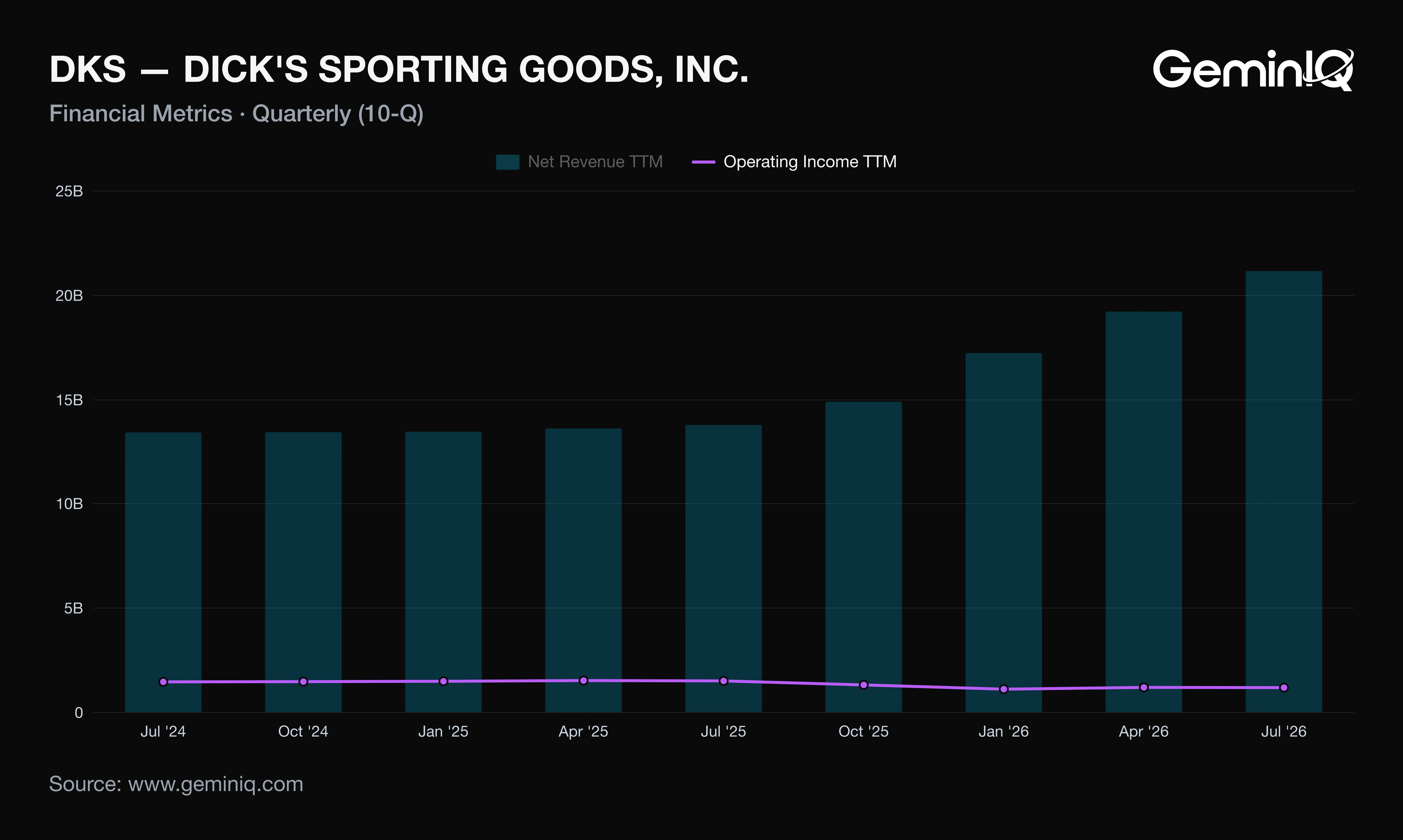
The filings explain the hesitation. With Foot Locker consolidated, trailing revenue grew 53.5% to $21.1 billion in the year to July 2026, yet trailing operating income fell 21.6%, from $1.49 billion to $1.17 billion. Trailing gross margin slid from 36.1% to 32.1%, trailing EPS fell from $14.83 to $9.44, and diluted shares rose from 81.0 million to 90.1 million. After a 30% drop, the trailing P/E is 20.7, higher than the 13.9 of a year earlier, because earnings fell faster than the price. The directors are buying a bigger company with a smaller profit, and a securities class action over the same period is pending. The cluster sits 5.1% in the money at Dick's October 9 close of $136.65.
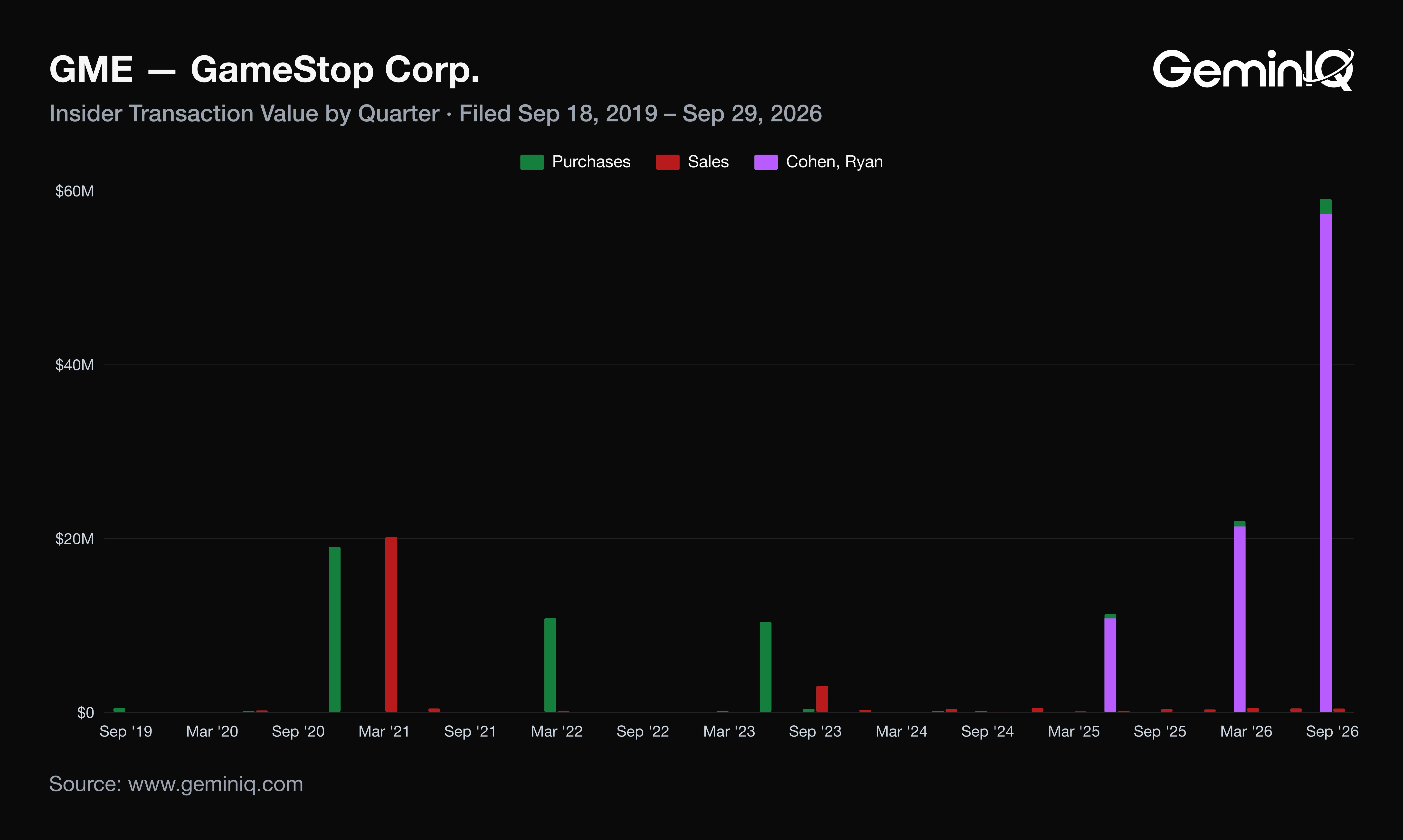
At GameStop, Ryan Cohen bought $78.7 million of stock in 2026: $21.4 million in January and $57.3 million in September at $20.38 to $23.46. Every open-market purchase by every GameStop insider from 2008 through 2025 adds up to $55.1 million. Directors Lawrence Cheng ($1.03 million at $18.80), James Grube and Alain Attal bought alongside him in September. The same Form 4 feed shows what routine trading looks like at the same company: General Counsel Mark Robinson and principal accounting officer Daniel Moore both sold on January 2, April 1 and July 1, 2026, in the first days of each quarter, the same rhythm they followed in January, April, July and October of 2025. Two officers selling on a calendar while four insiders bought in the open market, inside one company in one year, is the Cohen, Malloy and Pomorski split in miniature. GameStop's 10-Q shows a trailing operating margin of 13.5%, a record in its filing history, and a trailing P/E of 10.9, its lowest since 2017, though trailing revenue still fell 7.7% to $3.55 billion.
Two details belong next to the headline. Cohen's Schedule 13D filings say the purchases were made with personal funds that may include margin loans, and GameStop's warrants carry a $32 strike that expires October 30, 2026, about 20% above the October 9 close of $26.56. The largest holder buying a stock that needs to rise for the warrants to pay is a fair thing to debate. His September purchases are up 20.5% on a blended basis.
The Scorecard So Far
| Insider | Trade | Form 4 price | Oct 9, 2026 close | Change |
|---|---|---|---|---|
| Ryan Cohen, GameStop | Bought $57.3M, Sep 10 to 29 | $22.05 avg | $26.56 | +20.5% |
| Six insiders, Dick's | Bought $5.1M, Aug 26 to Sep 23 | $130.05 avg | $136.65 | +5.1% |
| Dara Khosrowshahi, Uber | Bought $10.0M, Sep 10 | $70.96 | $71.51 | +0.8% |
| Michael Mahoney, Boston Scientific | Bought $9.0M, Aug 3 | $48.33 | $42.73 | -11.6% |
| Mark Stevens, NVIDIA | Sold $947.6M, Aug 31 to Sep 18 | $223.65 avg | $229.28 | +2.5% |
| Jeff Bezos, Amazon | Sold $346.5M, Aug 3 | $286.41 | $262.43 | -8.4% |
Five to ten weeks is too short to grade any of these trades. The academic results cited above measure insider purchases over six to twelve months, and at least one of the strongest-looking setups in the group, Boston Scientific, is currently the worst performer. The record will be revisited after the January filings.
What These Six Companies' Own History Says
The same six companies have been filing Form 4s and 10-Qs since 2009, which makes it possible to check how insider buying at each of them has played out before. Every quarter from 2009 to 2026 was sorted by whether an officer or director bought in the open market, and each quarter's next-12-month return, measured from the quarter-end close in GeminIQ's Calculated Metrics, was compared with the median quarter for the same stock. Comparing a stock against itself keeps NVIDIA's decade-long rise from making every NVIDIA purchase look prescient.
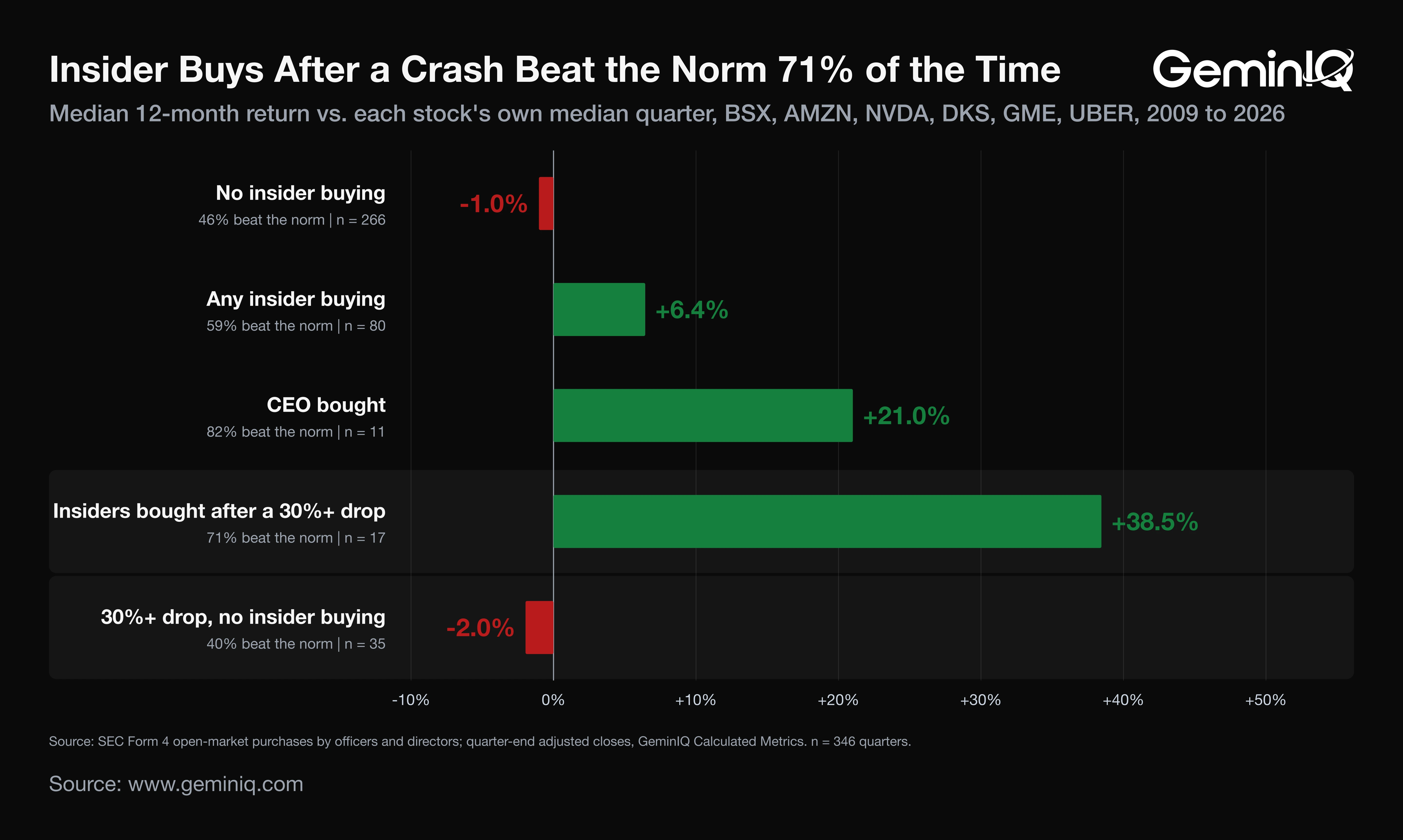
| Quarter type | Quarters | Median 12-month return vs. stock's norm | Share that beat the norm |
|---|---|---|---|
| No insider buying | 266 | -1.0% | 46% |
| Any insider buying | 80 | +6.4% | 59% |
| CEO bought | 11 | +21.0% | 82% |
| Insiders bought after a 30%+ drop | 17 | +38.5% | 71% |
| 30%+ drop, no insider buying | 35 | -2.0% | 40% |
The sharpest contrast is in the last two rows. When one of these stocks fell 30% or more from its highest quarter-end close of the prior year and insiders bought, the next twelve months beat that stock's norm 71% of the time. After drops of the same size with no insider buying, only 40% did. Removing GameStop, whose 2020 to 2021 run would distort any average, leaves 8 buying quarters at +35.7% and a 75% hit rate against -0.2% and 40% without buying. Two results run against intuition: quarters with $1 million or more of buying did no better than smaller ones (-4.5%), and buying while the operating margin was falling year over year was followed by better returns (+16.3%) than buying while it was rising (+0.3%).
Against that record, the Q3 2026 purchases do not line up the way their headlines suggest.
| Q3 2026 purchase | Price vs. prior-year high close | Fits the 30%+ drop pattern |
|---|---|---|
| Michael Mahoney, Boston Scientific, $48.33 | -55% vs. $107.41 | Yes |
| Six insiders, Dick's, $130.05 avg | -42% vs. $225.65 | Yes |
| Dara Khosrowshahi, Uber, $70.96 | -28% vs. $97.97 | Borderline |
| Ryan Cohen, GameStop, $20.38 to $23.46 | -18% to -6% vs. $24.95 | No |
The largest and most talked-about purchase of the quarter, Cohen's, is the one that least resembles what has worked at these six companies. The two that fit best, Boston Scientific and Dick's, are the two sitting on a loss or close to flat today. This is six hand-picked companies and 17 past drawdown events, not a forecast; a universe-wide version of the same test is the next GeminIQ study.
Check Your Holdings
The method behind this study runs on any company you own. Open its Insider Transactions view in GeminIQ and filter for code P purchases. For each buyer, look back through that person's own Form 4 history and answer three questions: when did this insider last buy in the open market, at what prices did they sell in between, and do their trades repeat on a calendar? Mahoney's 2014-to-2026 gap, Khosrowshahi's buys at $26 against sales at $100, and the January, April and July sales by two GameStop officers are each visible in under a minute. A purchase that breaks a long pattern is the opportunistic kind; a purchase that matches a schedule is not.
Then count the distinct buyers in the last 90 days against the company's own annual record, and check two lines in Calculated Metrics: P/E (TTM) against its own history, and operating margin (TTM) over the same window. Boston Scientific's buyers bought a falling multiple on a rising margin, and Dick's buyers bought a falling multiple on a falling margin. Neither combination should be dismissed on sight: across the six companies' history, buying alongside a falling margin was followed by the stronger twelve months. Finally, compare the current price with the prior year's highest quarter-end close. A purchase made 30% or more below it is the setup that has carried the most weight in this sample.
Frequently Asked Questions
How much stock did insiders sell in Q3 2026?
Individual officers and directors sold $21.0 billion in open-market Form 4 sales with transaction dates from July 1 to September 30, 2026, and bought $923 million, a ratio of $22.79 sold per dollar bought. There were 5,121 sellers and 1,371 buyers.
Who was the biggest insider seller in Q3 2026?
NVIDIA director Mark Stevens, with six sales totaling $947.6 million between August 31 and September 18, 2026. The top 51 sellers together accounted for 45% of all insider sale dollars.
Which CEOs bought their own stock in Q3 2026?
The largest open-market purchases by sitting CEOs included Ryan Cohen at GameStop ($57.3 million in September), Dara Khosrowshahi at Uber ($10.0 million) and Michael Mahoney at Boston Scientific ($9.0 million). In total, 289 CEOs bought and 680 sold.
How did insider buying at these six companies perform historically?
Across BSX, AMZN, NVDA, DKS, GME and UBER from 2009 to 2026, quarters with insider buying were followed by a median 12-month return 6.4 percentage points above each stock's normal quarter, and quarters where insiders bought after a 30%+ drop beat the norm 71% of the time (17 quarters). Quarters with the same size drop and no insider buying beat it 40% of the time (35 quarters).
Does insider selling predict stock returns?
Historically, much less than insider buying. Lakonishok and Lee (2001) found insider sales had no predictive ability for future returns, while Jeng, Metrick and Zeckhauser (2003) found purchases earned abnormal returns of more than 6% a year. Cohen, Malloy and Pomorski (2012) found the information is concentrated in opportunistic trades that break an insider's usual pattern.
Wall Street's data. Main Street's price.
Institutional terminals charge thousands a year for as-filed accuracy. GeminIQ gives you the same thing for a fraction of the cost: financials built directly from raw SEC EDGAR filings, not third-party APIs, with full XBRL traceability back to the original 10-K or 10-Q. No normalized guesswork, just calculated metrics, charts, screeners, and watchlists built on numbers exactly as the company reported them. Start researching now at GeminIQ.com.
All insider figures are drawn from SEC Form 4 filings, and all financial figures from each company's as-filed 10-K and 10-Q filings, publicly available on SEC EDGAR. Insider totals count open-market purchases (P) and sales (S) by individual officers and directors with transaction dates from July 1 to September 30, 2026, after removing duplicate joint filings, Form 4/A duplicates and rows with impossible reported prices. The six-company history uses quarter-end closing prices (adjusted for splits and dividends) from GeminIQ's Calculated Metrics, measuring each quarter's next-12-month return against that stock's median quarter from 2009 to 2026. Closing prices for October 9, 2026 are market data, not filing data.
Disclaimer: The content in this blog is for educational and entertainment purposes only and does not constitute financial, legal, or tax advice. Investing involves risk, including the loss of principal. The views expressed are my own and not intended as financial advice or a guarantee of future performance.